Baccarat explained: hand values, bets and drawing rules
18+ only. Casino games involve the risk of losing money. This guide explains rules; it does not provide a betting system or predict a result.
Baccarat is easy to follow once you know what the table labels mean. In the common Punto Banco format, Player and Banker are the names of two hands. You choose which outcome to back; you do not decide how either hand is played. Fixed rules determine whether a third card is dealt.
First check which baccarat format is on screen. Punto Banco, Chemin de Fer and branded versions can use different procedures, commissions and payouts. This guide explains common Punto Banco rules; the exact game’s information panel is the authority for the table you are viewing.
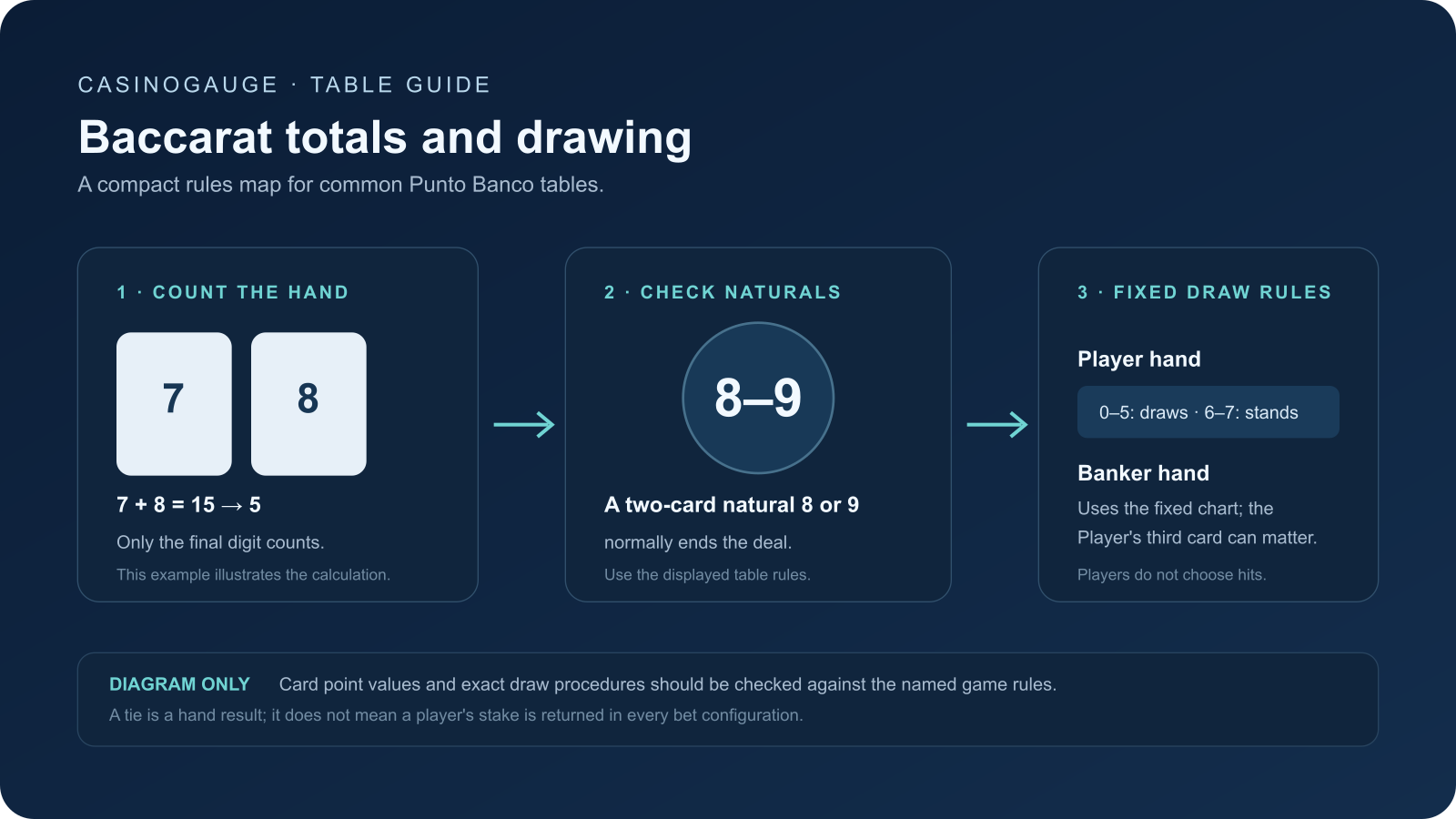
How baccarat card values work
In Punto Banco, aces count as one point, cards from 2 to 9 count at face value, and tens and picture cards count as zero. Only the final digit of a total is used: 7 and 8 add to 15, so that hand’s total is 5. The aim is for a hand to finish closer to 9 than the other hand.
At the start of a standard Punto Banco round, two cards are dealt to each hand. An initial total of 8 or 9 is a natural and ends the round. If neither hand has a natural, the Player hand’s total determines whether it draws; the Banker hand may then draw according to a separate rule.
What do Player, Banker and Tie mean?
The common main outcomes are:
- Player: the Player hand finishes closer to 9.
- Banker: the Banker hand finishes closer to 9.
- Tie: both hands finish on the same total.
These are labels for the two hands and the tie outcome. In Punto Banco, a customer does not choose what cards are drawn or make playing decisions for either hand. The Gambling Commission’s glossary defines Punto Banco as a game where players play against the bank rather than each other.
When does each hand draw another card?
In standard Punto Banco, the Player hand draws on a two-card total from 0 to 5 and stands on 6 or 7. A natural 8 or 9 ends the round before any third card is dealt.
If the Player stands on 6 or 7, the Banker draws on a total of 0 to 5 and stands on 6 or 7. If the Player draws a third card, the Banker’s decision depends on both its own two-card total and the value of the Player’s third card:
| Banker’s two-card total | Banker draws when the Player’s third card is… |
|---|---|
| 0, 1 or 2 | Any value from 0 to 9 |
| 3 | Any value except 8 |
| 4 | 2 to 7 |
| 5 | 4 to 7 |
| 6 | 6 or 7 |
| 7 | Never |
These are the common Punto Banco drawing rules, not a universal chart for every game called baccarat. A table may use a different format or add side bets and features. Check the exact game’s help panel before relying on a general guide.
Do Player, Banker and Tie always pay the same?
No. A payout or commission is part of a particular table’s terms. Some Punto Banco tables deduct commission from a winning Banker bet; Tie payouts may also differ by table. Side bets can have their own conditions and payout tables. Read the displayed rules for the exact table instead of assuming a figure from another casino applies.
CasinoGauge has not tested a live or RNG baccarat table and does not compare payout value, house edge or availability across operators. A higher displayed payout does not by itself show how likely an outcome is or make a bet a good choice.
Baccarat, Punto Banco and Chemin de Fer: what is the difference?
Baccarat can refer to a family of card games. Punto Banco is a format where the casino is the banker and the draw decisions follow fixed rules. Chemin de Fer is a different form in which the banker role and some draw decisions work differently. When a screen simply says “Baccarat,” open its help menu to see which rules apply.
Live, RNG and branded game-show versions can also differ. The visual style does not identify the rules; the table’s title, format and information panel do.
What to check before using a baccarat rules guide
Find the full game or table name and identify its format. Check the card-value rules, the natural-hand rule, the Player and Banker draw procedure, and what happens on a Tie. Then check the payout and commission wording, the listed side bets, table limits and any special feature terms. If one of those details is missing from the visible panel, leave it unknown rather than filling it in from a general guide.
The Gambling Commission’s RTS 3 says applicable rules, how the game works, likelihood-of-winning information and potential payouts must be available before a customer commits to gamble. CasinoGauge does not audit a table’s compliance or fairness; this page helps readers locate and understand the information shown for the version they are viewing.
For related UK consumer information, see how to verify a UK casino licence and safer-gambling controls. Read online casino bonus terms before treating a promotion as part of a game’s payout. Browse our casino game guides for related rules explainers.
Sources
- Gambling Commission glossary: Punto Banco, checked 24 September 2026.
- Gambling Commission RTS 3 — rules, game descriptions and likelihood of winning, checked 24 September 2026.
- William Hill: Punto Banco rules, checked 24 September 2026. Used as an operator-published example of common Punto Banco scoring and drawing rules, not as proof that every baccarat table uses the same settings.
- William Hill: Baccarat rules and bets, checked 24 September 2026. Used to cross-check common bet labels and that table terms vary; it is not an independent review.
Rules and source links checked: 24 September 2026. Game rules, settings and availability can vary by title and version; check the information panel for the exact game.