Safer-gambling controls explained
A plain-English guide to limits, breaks, self-exclusion and UK support services. These tools have different purposes; if gambling is causing harm, support is available.
Need help now?
The NHS lists the National Gambling Helpline, run by GamCare, on 0808 8020 133. It is free and available 24 hours a day, 7 days a week. The NHS gambling support guide also links to treatment services and support for family and friends.
If you want to stop accessing UK-licensed online gambling sites and apps, visit GAMSTOP directly. Check the service’s current terms and select an exclusion period that reflects your decision.
Last checked: 24 September 2026. Service details and regulatory requirements can change. Confirm them at the linked official sources.
Controls have different purposes
Account tools may include financial limits, time-outs, product blocks and self-exclusion. A tool’s name does not explain how it calculates a limit or when the restriction takes effect. Read the operator’s current help information, including whether the control applies to one product, one account or a wider group of services.
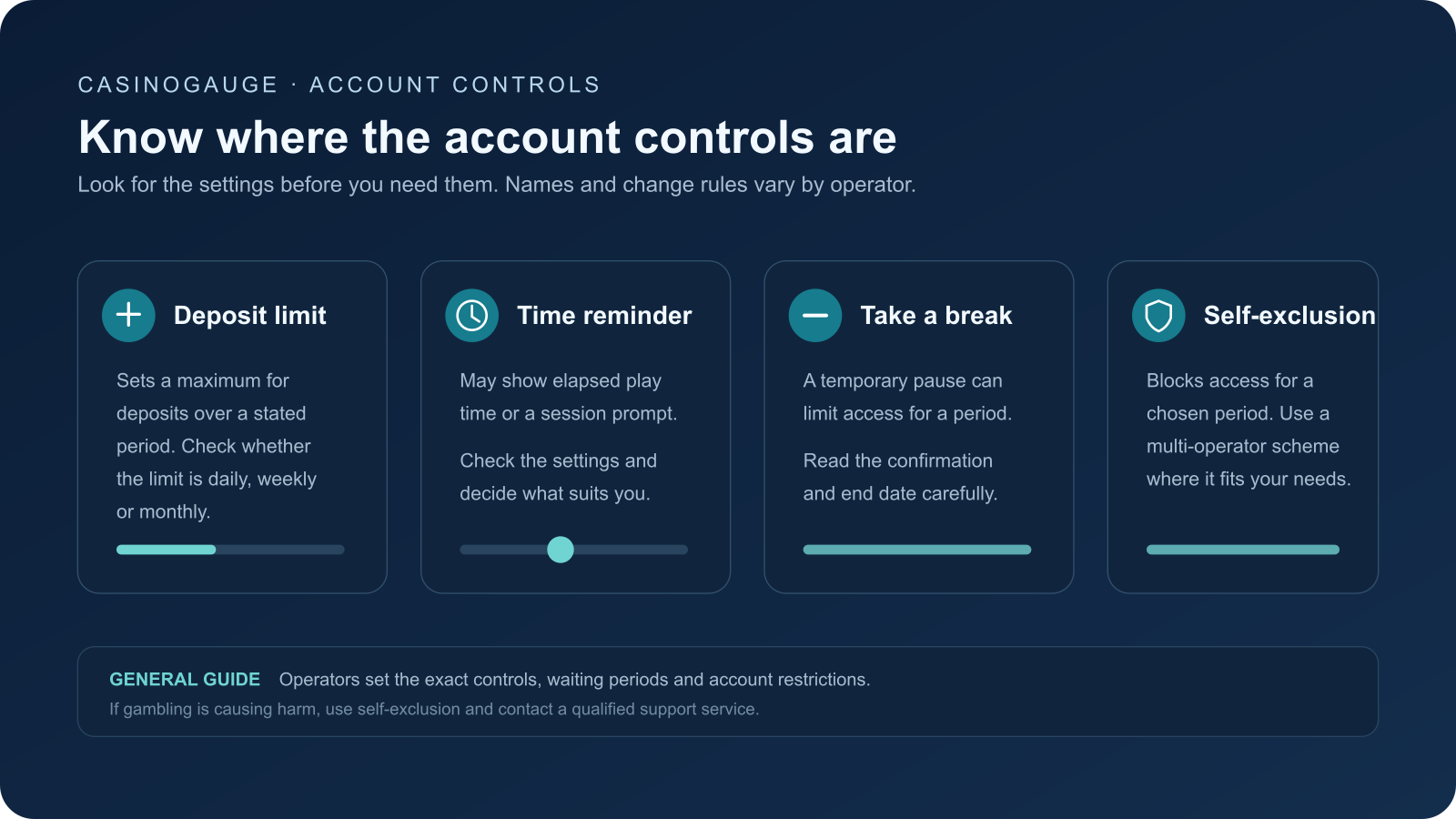
Deposit limits and other financial limits
The Gambling Commission’s updated Remote Gambling and Software Technical Standards take effect on 30 September 2026. The Commission says that from that date online operators must offer gross deposit limits, use the term “deposit limit” only for a limit based on the total amount deposited, and give that option at least equal prominence when other financial-limit types are offered. Other limits, such as stake or loss limits, use different calculations and should be clearly distinguished.
This is an upcoming implementation date as of this guide’s check date. It is not a claim that a particular operator has already updated its interface. See the Commission’s upcoming RTS changes for the current wording and implementation guidance.
From 30 September 2026, the minimum gross deposit limit must include 24-hour, 7-day and one-month periods and apply at account level at minimum. Where time frames overlap, the most restrictive limit must always apply. For example, a £10 daily limit plus a £100 weekly limit caps deposits at £10 per day and £70 per week. Once a deposit limit is reached, further deposits must be blocked until its period resets or the customer requests an increase. An increase may take effect only after a cooling-off period of at least 24 hours and a positive confirmation by the customer. Reductions must be implemented immediately unless a system or technical failure prevents this.
Operators may also offer other types of financial limit. A stake limit restricts the amount staked; a loss limit is stakes minus winnings or returns; and a net-deposit limit is deposits minus withdrawals. These are different measures and should not be labelled simply as a deposit limit. Only gross deposit limits must use fixed periods; other types may use fixed or rolling periods. This explains the published standard and does not verify any particular operator’s interface.
Update check: Recheck the Commission’s wording on or after 30 September 2026 before describing the changes as already in force.
Time-outs and breaks
A time-out is a temporary restriction offered by an operator. Its duration and effect depend on the product and operator. Check when it starts, what access it blocks and whether marketing contact is also paused. A time-out is not the same as a multi-operator self-exclusion scheme.
Self-exclusion and GAMSTOP
The Gambling Commission describes self-exclusion as a tool for people who want support to stop gambling. Licensed businesses must have arrangements for customers to exclude from that business. GAMSTOP is the multi-operator scheme for online gambling; a single request can cover participating UK-licensed operators. The NHS currently lists six months, one year and five years as the available online exclusion periods. Check GAMSTOP’s own site for the options and terms in force when you register.
Self-exclusion is a protective step, not a treatment or guarantee that every gambling route is blocked. The Commission advises seeking additional support and describes blocking software as one possible extra measure. A bank may also offer gambling-payment blocks. These options have different coverage; read each provider’s current terms.
Get support and treatment
The NHS explains how to find gambling treatment clinics and other support in England, and lists help for people affected by another person’s gambling. Services and referral routes can differ across England, Scotland and Wales. Use the current NHS guidance or contact a GP or the listed helpline to find an appropriate route.
What CasinoGauge can and cannot tell you
This guide summarizes public information. CasinoGauge has not tested these tools inside every operator account and does not recommend an operator. A displayed control does not establish that it will meet an individual need. For operator-specific information, consult the operator’s current terms; for help, contact a support service.
Official sources
- Gambling Commission: Self-exclusion — purpose of self-exclusion and operator arrangements. Checked 24 September 2026.
- Gambling Commission: Upcoming RTS changes — financial-limit changes taking effect 30 September 2026. Checked 24 September 2026.
- GAMSTOP — official online self-exclusion service. Check its current terms directly.
- NHS: Help for problems with gambling — support, treatment and helpline information. Checked 24 September 2026.
- Gambling Commission: RTS 12 wording effective 30 September 2026 — limit periods, account-level application, blocking and change rules. Checked 24 September 2026.
For a factual correction to this article, see CasinoGauge’s corrections policy.
Jurisdiction: The Gambling Commission guidance linked here applies to Great Britain. Regulatory arrangements differ in Northern Ireland.