How to Build a Casino Complaint Evidence File in the UK
CasinoGauge practical guide
Last checked: 2 October 2026. This guide is general information, not legal advice.
A practical UK casino complaint evidence file should record each issue clearly, protect sensitive information and prepare relevant evidence for the operator or its ADR provider.
A useful complaint file is a clear record of what happened, what you asked the gambling business to do and what evidence supports each point. It is not a public accusation and it should not contain more personal or payment information than the recipient needs.
The Gambling Commission says a customer should first use the gambling business’s own complaints process. Its guidance asks customers to include relevant dates, times and amounts, share supporting evidence and keep a copy of everything submitted. This guide turns those points into a repeatable, privacy-conscious working file. For the steps in the complaint process, see our guide to resolving an online casino complaint.
A visual walkthrough of the evidence file
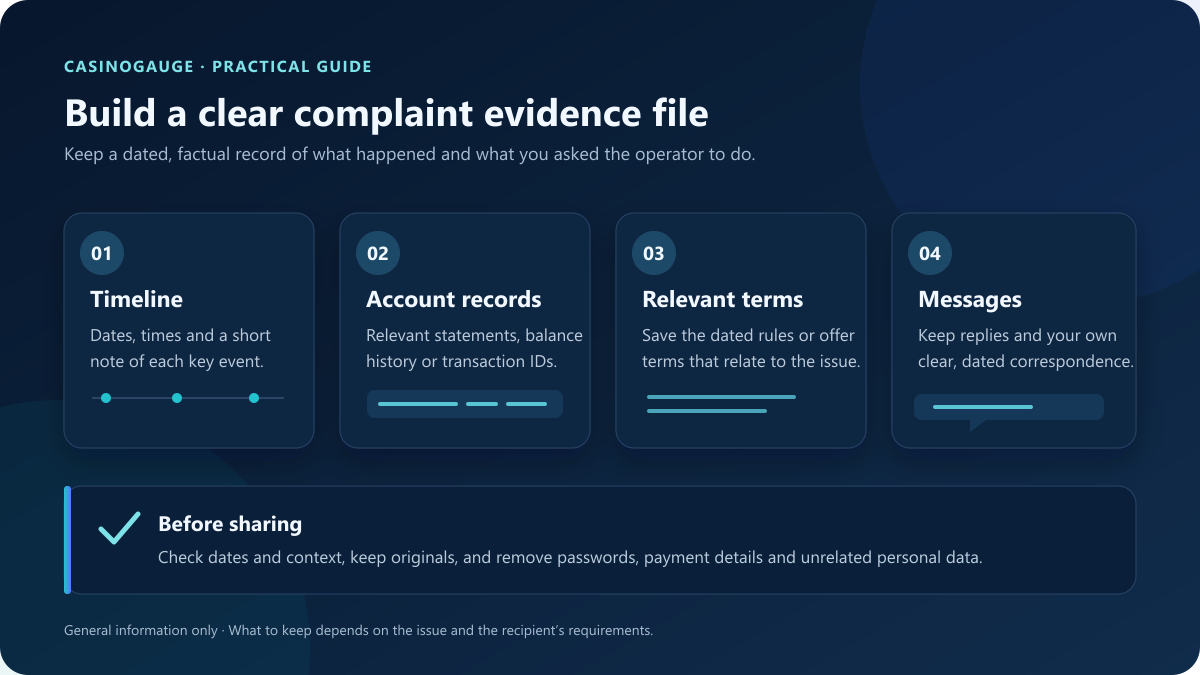
This short field guide shows how to organise a clear, privacy-conscious complaint record before sending it to an operator or, if appropriate, an ADR provider.
A visual guide to organising relevant records for an online casino complaint. Terms. Keep the terms that applied. Keep the terms linked to the disputed play or transaction. Record when they applied, save the relevant offer and general terms, then identify the exact clause in question.Complaint evidence field guide
Read transcript
Messages. Keep the full message trail. Save relevant messages with their dates, channel, sender and case reference. Keep replies in sequence, and redact unrelated personal details before sharing.
Transaction. Match the disputed transaction. Check the amount, date and status against your account history or payment record. Include the reference that identifies the item; remove unrelated activity and private account details.
Timeline. Put events in date order. Write a short factual sequence and link each point to a record. Separate what you observed from what the business confirmed, and label anything you are unsure about.
Escalation. Follow the complaint route. Use the operator’s published process first and keep its dates and replies. UK Gambling Commission guidance says unresolved complaints can be referred to the operator’s named ADR provider after eight weeks, or sooner after a final position; check eligibility and deadlines.
Keep a copy. Share carefully and keep originals. Send only requested records through a secure route. Keep the original files, your submission and the case reference. Evidence can help explain a dispute, but it cannot guarantee a particular outcome.
This general guide does not decide a complaint or replace the operator’s current process, the relevant ADR provider’s rules, or independent advice.
1. Start with one issue statement
Write a short description of the disputed event before collecting attachments. Identify the account, game or transaction only as precisely as needed, state the outcome you observed and explain the remedy you are asking the business to consider.
Keep observations separate from conclusions. For example, record the withdrawal request time, the status displayed and each message received. Do not describe a delay as unlawful, deliberate or universal unless qualified advice and evidence support that conclusion.
- Date and time the issue began
- Relevant transaction, game or support-reference number
- Amount involved, where relevant
- What the account or message displayed
- The specific response or remedy requested
2. Build a dated timeline
Create one row for every material event. Use the time zone shown by the operator or record your own time zone explicitly. Preserve the original order even if a later message corrects an earlier statement.
A timeline helps the operator and, if necessary, an Alternative Dispute Resolution provider distinguish the original transaction from later support conversations. It also prevents a long email thread from becoming the only record of the dispute.
- Event date, time and time zone
- Channel used: account, email, chat or telephone
- Who sent or displayed the information
- A neutral summary of the event
- The filename or reference for supporting evidence
3. Preserve terms and transaction evidence
Save the terms that applied to the relevant transaction or promotion, including the page address and capture time. Keep the full section needed to understand a condition rather than an isolated sentence. Record account and payment references, but redact full card numbers, security codes, passwords, identity documents and unrelated personal data from working copies.
If the dispute concerns wagering or offer conditions, see our plain-English guide to online casino bonus terms.
Screenshots should show enough surrounding interface to establish context. Keep an untouched original privately and use a redacted copy for submission when possible. A descriptive filename with its date and a redaction note is more useful than a generic name such as screenshot1.png.
- Applicable terms with URL and capture time
- Transaction or game-history export
- Redacted account-status screenshots
- Deposit or withdrawal reference without full payment credentials
- Copies of material chat and email messages
If your issue concerns a deposit route or withdrawal restriction, our guide to UK casino payment methods explains the relevant payment and balance distinctions.
4. Use the operator’s complaints procedure
Find the complaints procedure on the gambling business’s website and send the file through the stated channel. Ask for an acknowledgement or reference number and record the date the business received the complaint.
Current Gambling Commission guidance says the business generally has eight weeks from receipt to resolve the complaint. It also says a customer must go through the business’s complaint process before taking a dispute to an ADR provider. Record the current official guidance at the time you submit because procedures and regulatory information can change.
- Complaint-policy URL and access date
- Submission channel and delivery evidence
- Acknowledgement or complaint reference
- Date received by the business
- Each response, escalation and stated deadline
5. Prepare a clean ADR handoff if needed
The Gambling Commission explains that, after the business’s complaints process, an unresolved complaint may be eligible for an ADR provider. The business should identify the relevant provider and may issue a deadlock letter. An ADR provider considers information from both sides and first decides whether it can adjudicate the complaint.
Do not assume every disagreement falls within ADR scope. The Commission notes exclusions including customer-service issues and a business’s refusal to accept a bet or a customer. If court action is being considered, seek independent legal advice rather than treating this editorial checklist as legal advice.
Financial-business complaints follow a different route. This guide covers disputes with gambling operators, not complaints about banks, lenders or other financial businesses. The Financial Ombudsman Service says it may be able to help with some complaints involving gambling-related harm, including concerns about lending, account support or gambling-payment blocks. Complain to the firm first; you can contact the Ombudsman if you are unhappy with its final response or it has not sent one within eight weeks. Eligibility depends on the case; check the Financial Ombudsman Service guidance on gambling-related harm.
- The original complaint and every material attachment
- The operator’s final response or deadlock letter, if issued
- Evidence that the operator process was completed
- The ADR provider named by the business
- A short index matching each disputed point to its evidence
6. Keep a private master and a redacted submission copy
Store an untouched master file securely and create a separate submission copy. Remove passwords, authentication codes, full payment credentials, unnecessary identity-document images and information about other people. Check every screenshot and PDF page after redaction; drawing a translucent box over text may not remove the underlying data.
Keep a record of what was sent, to whom and when. Do not publish the complaint file as a player review or community submission. A personal dispute record is not evidence that the same result applies to other customers.
- Private original retained securely
- Submission copy reviewed page by page
- Sensitive fields removed rather than visually covered
- Recipient and transfer date recorded
- Public posting disabled unless separately consented and moderated
Limits of this checklist
- This guide is general editorial information, not legal advice.
- It does not decide whether a complaint is valid or within an ADR provider’s scope.
- Check the operator’s current procedure and official guidance when preparing a complaint because time-sensitive details can change.
- CasinoGauge has not reviewed the reader’s documents and does not receive identity documents or payment credentials through this page.
If gambling is affecting you or someone close to you, the NHS lists support and treatment options. GamCare’s National Gambling Helpline offers free, confidential support 24 hours a day. See the NHS guide to help for problems with gambling and GamCare’s current support options.
Official sources checked
- Gambling Commission — How to complain (accessed 25 September 2026)
- Gambling Commission — Taking your complaint to an Alternative Dispute Resolution (ADR) provider (accessed 25 September 2026)
- Financial Ombudsman Service — Complaints that involve gambling-related harm (accessed 2 October 2026)
- NHS — Help for problems with gambling (accessed 2 October 2026)
- GamCare — Current support options (accessed 2 October 2026)
Procedures and official guidance can change. Recheck them when preparing a complaint.