Online blackjack rules explained: hands, payouts and table settings
18+ only. Casino games involve the risk of losing money. This is an educational guide, not a casino recommendation or prediction.
Blackjack is a card game in which a player’s hand is compared with the dealer’s hand. The aim is to finish closer to 21 than the dealer without going over 21. A natural blackjack is an Ace with a ten-value card as the first two cards. The familiar objective is shared across many versions, but details such as the natural-blackjack payout, dealer behaviour on a soft 17, splitting conditions and number of decks can vary.
This guide explains common terms so readers can find and understand the rules for a particular table. It is not a strategy chart, advice on what action to take, or a claim that blackjack can produce a predictable outcome. Check the game’s own “Help”, “Rules” or “Paytable” panel before treating any general description as applicable.
How blackjack hands are counted
Number cards count at their printed value. Jacks, queens and kings count as 10. An Ace can count as 1 or 11, whichever gives the hand a legal total that is better without going over 21. For example, an Ace and a 6 can count as 7 or 17. This is often called a soft 17 because the Ace can be counted as 1 if another card would otherwise take the hand over 21. A hand with no Ace counted as 11 is commonly described as a hard hand.
If a hand total goes over 21, it busts and normally loses. A hand at 21 is not automatically a natural blackjack: the hand may have reached 21 using three or more cards, or it may have come from split cards. Whether those hands are paid differently is a table-rule question.
In standard dealer-versus-player blackjack, each player competes against the dealer rather than against other players at the table. The dealer follows the game’s fixed rules instead of choosing freely between hit and stand. One table may require the dealer to stand on a soft 17; another may require a hit. Check the selected game’s own rules for the dealer’s action and other table settings.
What happens in a round?
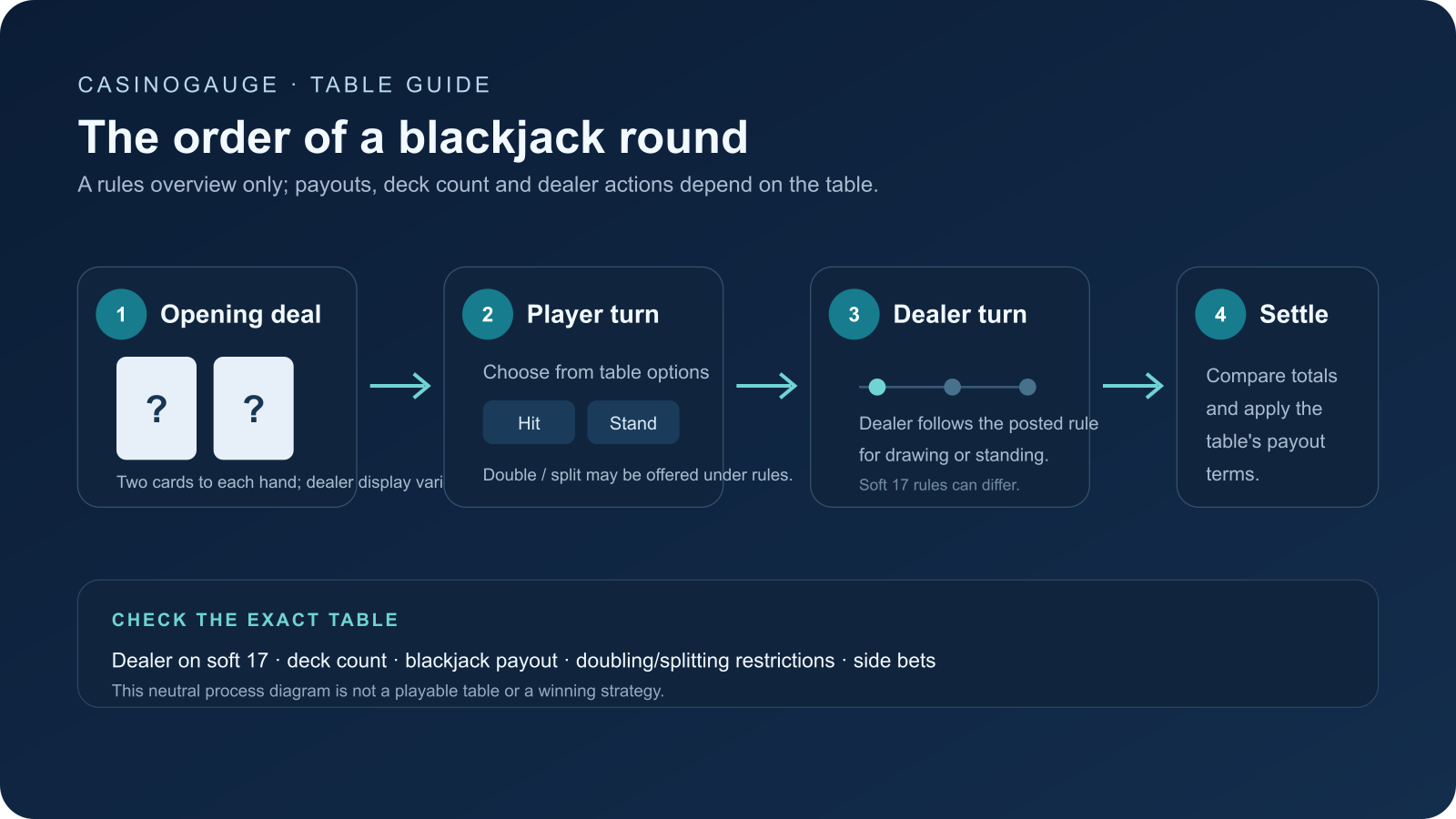
The precise deal sequence can differ between live and software games, but a common round follows this outline:
- The table accepts a stake and deals the initial cards.
- The player sees their hand and the dealer’s visible card or cards, as defined by the game.
- The player may have choices such as hit, stand, split, double or surrender, but only if the rules offer them for the current hand.
- After player actions finish, the dealer completes their hand under the stated dealer rules.
- The game compares the hands and settles the stake under its payout and tie rules.
The order of dealer checks, whether a hole card is used, and how additional wagers are treated against a dealer blackjack are not universal. Use the named table’s rules panel for details rather than assuming the sequence from a different game.
Common player actions
These labels describe common actions. Availability and restrictions are table-specific; the panel may limit an action based on the hand, first cards or dealer card.
- Hit: request another card.
- Stand: take no more cards and end the player’s actions for that hand.
- Double down: increase the stake under the table’s doubling rule, usually receiving a specified number of additional cards. Some games restrict which first hands can double.
- Split: separate an eligible starting pair into two hands and place an additional stake as required by the rules. Games differ on which values can be split, how often hands can be re-split, and what happens after splitting Aces.
- Surrender: in versions that offer it, forfeit a hand under specified conditions for a stated part of the stake. It may not be available after certain cards are dealt or after another action.
- Insurance: a separate side wager sometimes offered when the dealer’s visible card is an Ace. Its payout and treatment are set by the rules. It is separate from the main hand.
Do not infer that a button appearing in another blackjack game will be present here. Find the current table’s action descriptions before beginning.
Blackjack, 21 and ties
A natural blackjack usually means the first two cards are an Ace and any ten-value card. A three-card 21 is generally not the same hand, but the precise comparison and payout language should be checked in the table rules. Where the player and dealer finish with the same total, a tie is often called a push and the stake is returned; some variants can define exceptions, so confirm the wording.
The dealer’s fixed drawing rule matters to the game. One table may require the dealer to stand on all 17s, while another may require a hit on soft 17. A soft 17 and a hard 17 are not interchangeable: soft 17 includes an Ace counted as 11; hard 17 does not. Record exactly whether the rules say “stand on soft 17” or “hit soft 17”.
Payouts: read the multiplier carefully
The regular win on a non-blackjack hand often pays even money, but the table rules are authoritative. Natural blackjack can have a distinct payout. A familiar example is 3:2: for a £2 stake, that convention means £3 in winnings plus the £2 stake returned, for £5 total returned. Some tables use a different payout, such as 6:5, under which a £2 stake would earn £2.40 in winnings plus the returned stake, for £4.40 total. Confirm whether the screen labels net winnings or total return before comparing payout wording.
A lower natural-blackjack payout changes the possible return on that hand. It does not tell you what will happen in a particular round, and it should not be converted into a promised session result. If the rules provide an RTP or house-edge figure, retain its assumptions and scope; blackjack figures depend on multiple rules and on the method used to calculate them.
Table settings worth recording
Blackjack versions can differ in several details that affect how hands are played or settled. Before comparing two games, record the settings from each game’s own panel:
| Setting | What to check |
|---|---|
| Natural blackjack payout | The exact multiplier and whether it applies only to an initial two-card blackjack |
| Dealer on soft 17 | Whether the dealer hits or stands when the hand is soft 17 |
| Decks | Number of decks, if disclosed, and any stated shuffle information |
| Double down | Eligible starting hands and any restrictions |
| Splitting | Which pairs can be split, re-split limits, and rules for split Aces |
| After-split play | Whether doubling or further splitting is allowed after a split |
| Surrender | Whether offered, when it can be used, and what happens to the stake |
| Insurance | When it is offered, how it pays, and how the side wager is settled |
| Dealer blackjack | Whether extra split/double stakes are affected, where the rules explain this |
| Table limits | The minimum and maximum stake currently displayed for this table |
Leave a field blank or mark it “not shown” if the rules do not provide the answer. Do not fill gaps using a different table, a general strategy chart, a provider’s other game or a casino brand’s standard rules page.
Online and live-dealer blackjack
An online table may be software-generated or presented with a live dealer. A product description or game label should identify the format. A photographic table background does not establish that a live dealer is present. In a live product, the stream and interface may add timing, seat, language or interaction details; those are not substitutes for the rules governing cards, choices and settlement.
For a particular product, check the rules panel available before play. The Gambling Commission’s remote-gambling standards say applicable game rules and information about the way a game works, payouts and likelihood of winning must be available before a customer commits to gamble. This is a useful reason to look for the actual game help panel, rather than relying on an affiliate summary or a generic game guide.
Common blackjack misunderstandings
“A 21 always pays like blackjack”
Not necessarily. The game can distinguish an initial two-card blackjack from a 21 reached later, and a hand made after a split may also be treated differently. Read the natural-blackjack definition and payout conditions.
“The dealer always stands on 17”
Not across every table. Check the separate rule for soft 17 and note that it may differ from the rule for hard 17.
“All pairs can be split the same way”
Splitting rules vary. A table may treat pairs with equal value differently from identical ranks, restrict re-splitting, or limit play after splitting Aces. Use the exact conditions on the selected table.
“Past cards guarantee what comes next”
A short sequence of cards does not guarantee the next card or round. Do not use a recent-results display as a prediction. The applicable game rules describe the hand and settlement; they do not make a future result certain.
How to check a specific blackjack table
Open the named table’s Rules, Help or Paytable screen and save the source record if documenting it. Note the game and provider title, version/build if visible, the date, and the exact rules listed for payout, soft 17, decks, splits, doubles and surrender. For an article or comparison, transcribe from that same visible panel and keep a record of what was unavailable. If a setting matters but is missing or ambiguous, contact the operator or provider instead of guessing.
A screenshot can record what a particular rules panel showed at a particular time. It cannot demonstrate that every account sees the same configuration, that every game from the provider has the same rules, or what any future hand will do. CasinoGauge has not tested or reviewed a specific operator table for this guide.
If you are checking the business behind a table, our UK casino licence guide explains the domain and licence checks to make. Our safer-gambling controls guide describes general tools for setting limits; neither page verifies a blackjack game’s rules or recommends a particular table.
Frequently asked questions
What is a soft 17 in blackjack?
A soft 17 is a hand that totals 17 while an Ace is counted as 11, such as Ace–6. It can often be re-counted with the Ace as 1 if another card is taken. Check whether the dealer must hit or stand on a soft 17 at the table you are viewing.
What does blackjack pay at 3:2?
Under the usual payout convention, 3:2 means a winning natural blackjack earns one and a half times the stake as profit, with the original stake returned. A £2 stake would earn £3 and receive the £2 stake back. Read the table’s payout key to distinguish winnings from total return.
What is the difference between a hit and a stand?
A hit asks for another card under the table’s rules. A stand ends the player’s actions for that hand. The buttons and permitted actions can depend on the hand and the version of blackjack.
Does blackjack always use six or eight decks?
No. The number of decks depends on the game. Some rules panels state a deck count or shuffle information; others may not make it visible in the current view. Record only what the selected game discloses.
Is blackjack the same as reaching 21?
Not always. A natural blackjack generally means an Ace and a ten-value card as the initial two cards. A hand that reaches 21 with additional cards may be treated as an ordinary 21. The game rules define the distinction and payout.
Explore our CasinoGauge casino game guides for clear explainers of roulette, slots, baccarat and live formats.
Sources
- The Gambling Commission’s RTS 3 guidance on game rules and likelihood of winning describes the information remote game rules should make available before play, including applicable rules, payouts and information about likelihood.
- This guide uses general terminology and a clearly labelled 3:2 versus 6:5 arithmetic example. It does not quote a CasinoGauge or operator house edge, publish a strategy chart, recommend an action, or represent firsthand product testing.
Rules and source links checked: 24 September 2026. Game rules, settings and availability can vary by title and version; check the information panel for the exact game.