Online roulette explained: wheels, bets, rules and odds
18+ only. Casino games involve the risk of losing money. This is an educational guide, not a casino recommendation or prediction.
Online roulette is built around one random result: the pocket where the ball comes to rest. The table lets a player select one number or a group of numbers before the spin. A result can settle a winning bet, return a stake under a stated rule, or lose it. The available bets, payouts and zero rules depend on the version of roulette, so check the information screen for the exact table rather than assuming every game uses identical rules.
This guide explains common roulette terms and the arithmetic behind standard single-zero and double-zero examples. It is a rules explainer, not a betting system or a recommendation to play. A previous spin does not make a number or colour due on the next one.
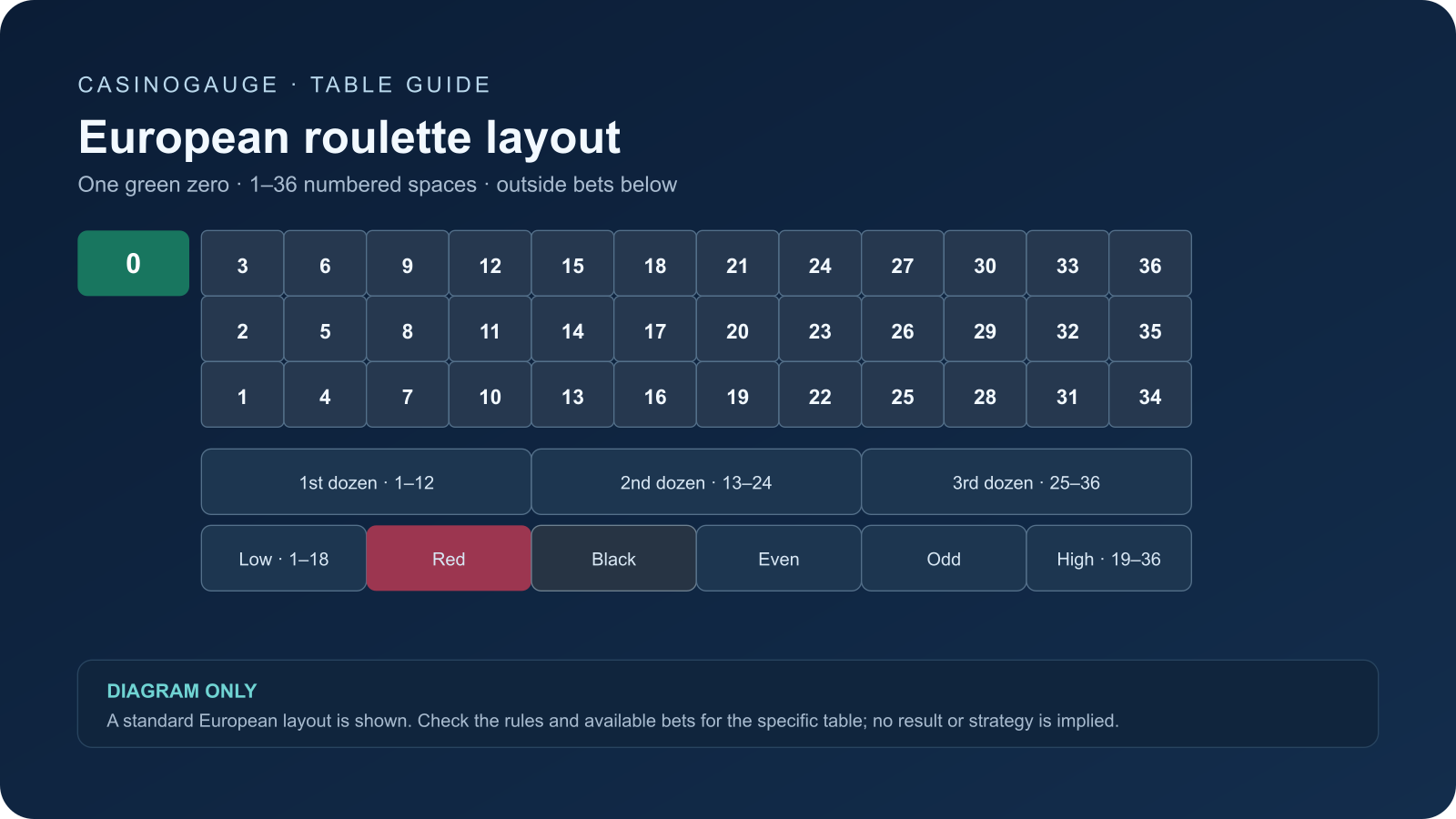
Start by identifying the roulette version
Check the game or table name, the wheel layout and the rules panel. A useful first question is how many pockets the wheel has:
| Common format | Pockets | Zero pockets | What to verify |
|---|---|---|---|
| Single-zero / European | 37, numbered 0–36 | One green 0 | Whether any special zero rule is stated |
| Double-zero / American | 38, numbered 0–36 plus 00 | Green 0 and 00 | Whether the displayed bet pays and covers the numbers you expect |
| French-labelled roulette | Usually 37 | Usually one green 0 | Whether La Partage, En Prison, or another rule is actually included |
Names are helpful clues, not a substitute for the displayed rules. Different games can use different layouts or extra features. Record the rules shown for the particular game you are looking at, including any special bet, side feature or payout condition.
Online roulette may use a computer-generated outcome or a streamed physical wheel. The lobby label and product description should say which format is being offered. A graphic that resembles a wheel is not enough to establish that a live stream is involved. In either format, use the title’s help panel to check the applicable rules and table limits.
Inside and outside bets
The betting layout is commonly grouped into inside bets and outside bets. “Inside” and “outside” describe where a selection appears on the layout; they do not describe a safer or better choice.
Inside bets cover a smaller group of numbers
Inside selections are placed on or around numbered squares. Common examples include:
- Straight-up: one number.
- Split: two adjacent numbers on the layout.
- Street: a row of three numbers.
- Corner: four numbers meeting at a corner.
- Six line: two adjoining rows, covering six numbers.
The payout label generally increases as the selection covers fewer numbers, but the chance of a hit also changes. Check the game’s payout table for the exact selection and any exceptions, especially for bets involving zero.
Outside bets cover broader groups
Outside selections commonly include red or black, odd or even, low (1–18) or high (19–36), a dozen, or a column. They cover more numbered outcomes than a straight-up bet. The green zero pocket or pockets still matter: a colour, parity or low/high selection normally does not include zero, so those outcomes do not count as a win unless the table has a special rule that says otherwise.
The two colours do not cover every pocket. On a standard single-zero wheel, red and black each appear on 18 pockets, with one green zero. On a standard double-zero wheel, each colour still appears on 18 numbered pockets, but there are two green pockets. This is why calling red/black “50/50” leaves out an important part of the wheel.
How payout notation works
Roulette tables commonly show payouts as a ratio such as 35:1. Read the game’s own payout key because interfaces may present “profit” and “total return” differently. Under the usual meaning, a 35:1 winning payout returns 35 times the stake as winnings, plus the original stake. A £1 winning straight-up bet would therefore receive £35 in winnings and its £1 stake back, for £36 returned in total, assuming no special condition applies.
This payout does not mean a one-number bet is likely to win. On a single-zero wheel there are 37 pockets and one number selection covers one pocket. The chance for that one spin is therefore 1 in 37, if each pocket is equally likely. The standard 35:1 profit payout is lower than the 36:1 profit that would make this particular bet break even over a very large number of independent spins; that difference is reflected in the standard single-zero roulette house edge.
Always check whether the table’s displayed figure is written as net winnings, total return, or a special payout. Do not compare two games until the payout labels and zero rules have been read the same way.
Roulette odds and the zero pocket
The following calculations are for the stated standard layouts and common payouts. They are arithmetic examples, not a forecast for an individual session. A roulette game can have a different layout, payout, special rule or feature, so use its own rules panel before applying the example.
Single-zero example
For a standard single-zero wheel, a red selection covers 18 of 37 pockets. Its chance of winning a spin is 18/37, or about 48.65%, where all pockets are equally likely. With a standard even-money payout, the expected loss per unit staked is 1/37, about 2.70%, over many spins. The same basic calculation applies to common even-money outside bets that cover 18 numbers and lose on zero.
Double-zero example
For a standard double-zero wheel, a red selection covers 18 of 38 pockets. Its chance is 18/38, or about 47.37%. With the same even-money payout, the expected loss per unit staked is 2/38, about 5.26%, over many spins.
For a simple bet with no push, the expected loss per unit staked is probability of losing − (probability of winning × net-profit multiple). For a one-unit stake on red in single-zero roulette, that is (19/37 × £1) − (18/37 × £1), or £1/37 lost per £1 staked on average. If a rule can return or hold a stake, include that outcome using the exact terms shown in the game’s rules. This long-run expectation does not state what any next spin will do.
La Partage or En Prison can change how an even-money bet is treated when zero appears. The name alone is not enough to calculate the result: confirm the exact rule and bet types covered on the table. If the panel is unclear, treat that detail as unknown rather than borrowing a rule from another French-labelled game.
What does the house edge tell you?
The house edge is a theoretical long-run average under a specific set of rules. It is not a fee charged on each spin, a statement about a particular operator’s integrity, or the proportion an individual session will lose. Short sessions can finish above or below the mathematical average. The figure also does not make a game suitable or predict how a particular result will fall.
For standard European single-zero and American double-zero roulette, the example percentages above follow from the pocket count and conventional even-money payout. Do not transfer those percentages to a table that uses different payouts, additional bets, zero rules, a bonus feature, or another layout. If an operator or provider publishes a return figure for a named game, check the scope, method and version attached to it; a generic label is not evidence for every configuration.
A quick checklist for a specific online table
Before relying on a general roulette guide, open the exact game information and note:
- The full game/table title and provider, if shown.
- Whether the result is generated by software or comes from a live-dealer wheel, according to the product description.
- The number range and the presence of 0, 00 or other pockets.
- The payout for the bets you want to understand and whether the display means winnings or total return.
- Any zero rule, extra feature, side bet or special payout condition.
- Minimum and maximum stakes displayed for that table, if you need to understand its limits.
- The help/rules page date or version, if one is displayed.
If a detail is missing, ask the operator or provider for the applicable rules. A lobby tile, brand name or screenshot from another version cannot fill in a missing rule.
If you are also checking the site that offers the table, our UK casino licence guide explains how to compare an exact domain with the Gambling Commission’s record. Our safer-gambling controls guide covers general time and money controls; neither guide verifies the settings of an individual roulette game.
Roulette myths: patterns do not change the next spin
Roulette result history can make recent patterns visible, but a run of red does not force black to appear next. Under the standard game model, each spin is a separate outcome; past results do not change the wheel’s pocket count or the rules for the next spin. A displayed “hot” or “cold” list is a record of past results, not a prediction.
Betting systems that increase or change a stake after a loss cannot remove the zero pocket or change the payout table. They also do not turn a negative long-run expectation into a guaranteed profit. A sequence can continue longer than a player expects, and a table limit or personal budget can be reached first. No system can guarantee a roulette result.
Common questions
How many numbers are on a roulette wheel?
A standard single-zero wheel has 37 pockets, numbered 0 through 36. A common double-zero wheel has 38 pockets: 0, 00 and 1 through 36. Check the wheel or rules panel for the game you are viewing, because variants may differ.
Is red or black a 50/50 bet?
Not on a standard roulette wheel with a green zero. Red and black each cover 18 numbered pockets, while zero (and 00 on a double-zero wheel) is outside both colours. On a standard single-zero wheel, the chance of red is 18/37; on a standard double-zero wheel it is 18/38.
What is the difference between European and French roulette?
Both labels are commonly associated with a single-zero, 37-pocket layout, but the exact rules can differ. French roulette may include a rule such as La Partage or En Prison for eligible even-money bets. Check whether the table actually includes the rule and what it says happens on zero.
What does 35:1 mean in roulette?
It usually means 35 units of winnings for each unit staked on a winning bet, with the original stake also returned. Check the interface’s payout key: some screens show net winnings while others show the total return.
Can a roulette strategy predict the next number?
No betting progression or past-results pattern changes the stated odds of the next standard spin. A strategy can change which selections a person makes or how much is staked, but it cannot guarantee a result or remove the house edge in the standard examples described here.
Is live roulette different from online roulette?
“Online roulette” describes access through a website or app. It may refer to a software-generated game or a streamed live table. Confirm the format in the operator’s product description and check that table’s rules; the word “live” should not be inferred from the artwork.
Sources
- The Gambling Commission describes roulette as an example of a game whose outcome is determined entirely by chance: Is the game played on the machine a game of chance?.
- UK remote-gambling technical standards explain requirements for fair result determination and game rules: RTS 5 – Result determination, RTS 7 – Generation of random outcomes, and RTS 3 – Rules, game descriptions and the likelihood of winning.
- The pocket counts, probabilities and house-edge examples on this page are calculated from the stated standard layouts and payout assumptions; they are not transcribed from an operator’s live game.
Rules and source links checked: 24 September 2026. Game rules, settings and availability can vary by title and version; check the information panel for the exact game.
Explore our casino game guides for clear explainers of other game formats.