Online slots explained: symbols, features, paytables and RTP
18+ only. Slot games involve the risk of losing money. RTP is a long-run theoretical figure, not a forecast for your session. No slot or feature can make a win predictable.
Quick answer: Before you play an online slot, open its help or paytable and check how wins are formed, what each special symbol does, the feature conditions, and any displayed RTP or odds. Those rules apply to the title and configuration on screen. RTP is a long-run theoretical figure; it cannot tell you what one session will return.
Online slots can look alike in a lobby and work quite differently once you open them. One title may use fixed paylines; another may count symbol patterns in a different way. Features and payout rules vary too. The quickest way to get past the artwork and marketing language is to open the game’s own information panel.
This guide walks through what to look for and how to interpret it. It does not rank games or promise a winning approach.
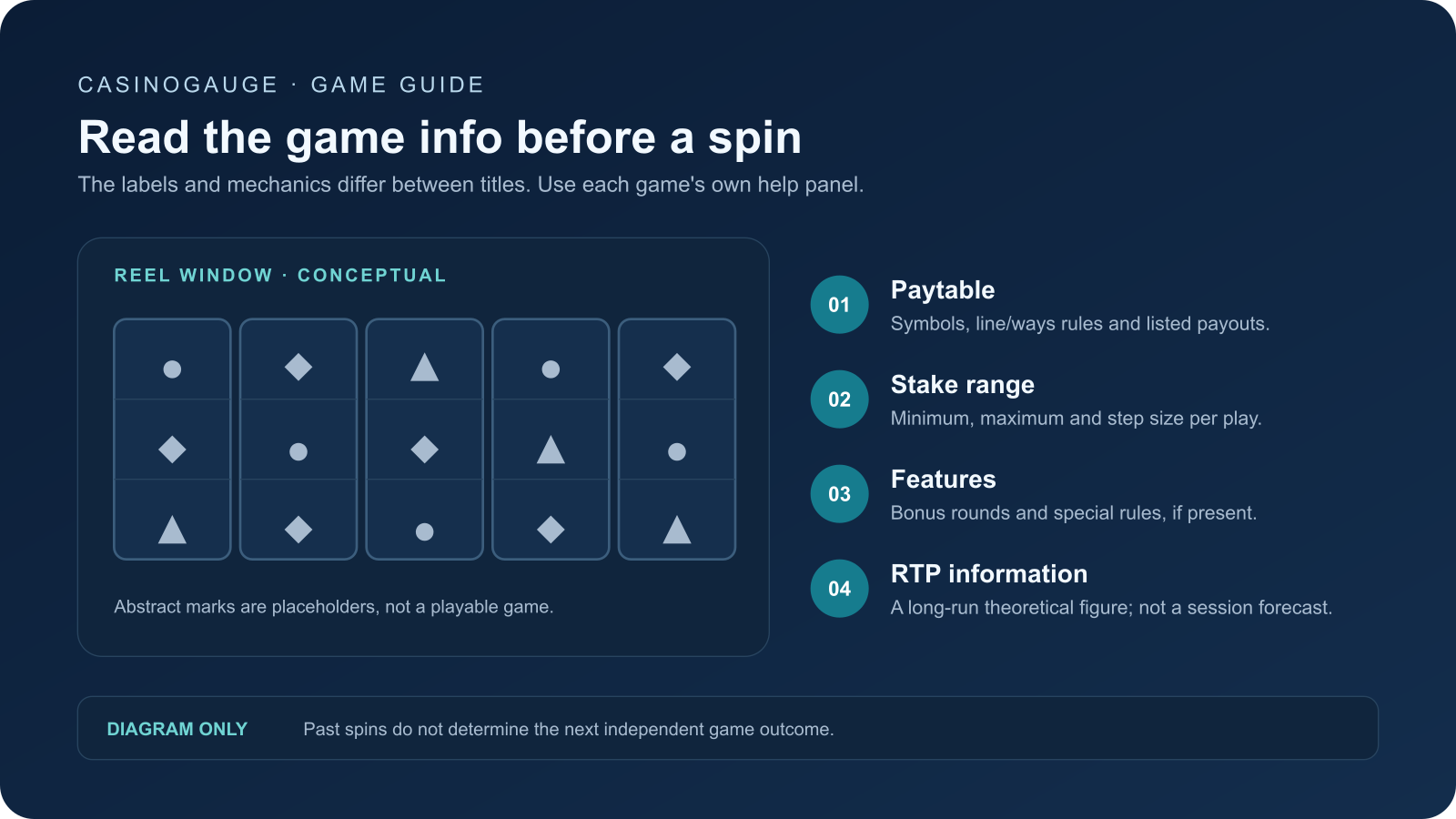
What counts as an online slot?
Most online slots show reels and symbols, but the important part is how that particular game scores a result. Some use fixed paylines, others use “ways,” clusters or another pattern described in the rules. Bonus rounds and special symbols also have title-specific conditions.
Start by noting the game’s full title and provider. If the name or version is unclear, a page about a similarly named game may describe different rules.
How to read a slot paytable
The paytable explains winning combinations and possible payouts. Look for it under a help icon, menu, question mark or information button. A lobby tile or short game description is only a preview; the paytable is where the rules should be set out.
Check these items:
- How wins are formed. Find whether the game uses paylines, ways, clusters or another format. A payline is a defined path across reels; a ways system may count matching symbols across adjacent reels. The rules screen should explain the game’s own pattern and any direction requirements.
- Symbol values. Check how many matching symbols are needed and whether position matters. The paytable may give different values for different symbols or combinations.
- Special symbols. Read the exact descriptions for wilds, scatters, bonus symbols and any substitutes. A wild does not necessarily replace every symbol or appear in every feature.
- Stake and payout basis. Check whether amounts are shown per line, per way, per coin, per total stake or in another unit. Do not compare a displayed prize amount with another game until you understand the basis.
- Feature triggers and restrictions. Look for the number or pattern needed to trigger a feature, the number of spins or choices involved, and any conditions or limits stated for it.
- Maximum win and jackpot rules. If a maximum or progressive prize is advertised, read how it is reached, whether a contribution is made, and whether other conditions apply.
- Return and likelihood information. Check whether the panel gives RTP, probabilities, or other information about the chance of winning. Record the wording and the exact game configuration rather than copying a figure from a different version.
For remote games in Great Britain, the Gambling Commission’s RTS 3 says the applicable rules should be easy to find before a customer commits to gamble, with accurate information about how the game works, the chance of winning and payouts. That gives you a good reason to open the game’s own rules panel. It does not mean CasinoGauge has tested a particular title. Gambling Commission: RTS 3 — rules, game descriptions and likelihood of winning
Great Britain online slot stake limits
Great Britain has a maximum stake per online slot game cycle: £5 for adults aged 25 or over, and £2 for adults aged 18 to 24. The limit applies to online slots; the Gambling Commission says it does not apply to other casino games such as roulette or blackjack. A game cycle runs from starting the game until the staked money is lost or any winnings are made available. Check the amount shown in the exact game’s stake controls. These are legal maximums, not recommended amounts or a limit on how much a person may lose over a session. Gambling Commission: Online slots stake limit guidance
Paylines, ways and clusters are not interchangeable
The words “payline,” “ways,” and “cluster pays” describe different ways a game can define a winning combination. A game may also use a less common format. The number of lines or ways shown in one title does not tell you the odds of winning in another, and a higher count alone does not mean better value.
Use the rules panel to answer three practical questions: What symbols must match? Where must they land? How does the game calculate the payout for the selected stake? If the explanation is unclear, do not infer the answer from an animation or a familiar-looking reel layout.
What do wild, scatter and bonus symbols mean?
These are common labels, not universal rules.
- A wild often substitutes for another symbol in some combinations, but its allowed substitutions and any excluded symbols are game-specific. Some wilds only operate in certain reels or features.
- A scatter may pay or start a feature when a required number appears, sometimes regardless of a payline. Check the title’s own paytable for the number, locations and conditions.
- A bonus symbol may start a separate round or feature. The entry condition, choices, number of rounds and payout rules vary. The feature name alone does not describe its likelihood or expected result.
- Multipliers, expanding symbols, respins and free-spin labels each need their own rule text. They do not, by themselves, establish that a feature is frequent or that it improves the result of a session.
Read the description for each symbol and feature in the exact game that is open. A short promotional summary may omit restrictions that appear in the full rules.
What RTP means on an online slot
Return to Player (RTP) is a theoretical percentage describing the share of total stakes a game is designed to return over a very large number of plays, under the game’s mathematical model. It is not the percentage of your own stake that will come back, a guarantee that a particular player will receive that amount, or a session target.
For example, a displayed RTP of 96% does not mean a player should expect to get £96 back after staking £100 in one sitting. Individual outcomes can differ substantially from a long-run average. The UK Gambling Commission’s technical standards call for relevant information about game rules, likelihood and payouts to be made available; its testing strategy also describes operator monitoring of actual RTP against expected RTP over volumes of play. Neither fact makes the theoretical figure a short-term prediction. Gambling Commission: RTS 3 · Gambling Commission: live RTP monitoring
When you see an RTP value, ask:
- Does it belong to the exact title and configuration currently open?
- Is it stated in the game’s help panel or another clearly linked source?
- Is it a theoretical RTP, and is the wording explained?
- Does the panel show more than one possible setting or version?
- Is the information dated or tied to a market/operator configuration?
If a number comes from a third-party game directory, treat it as a lead to verify, not a replacement for the current in-game rules. If no RTP is visible in the captured view, say so; do not fill the gap from memory.
What volatility can—and cannot—tell you
Volatility (sometimes called variance) is a description of how results may be distributed over time: for example, whether returns tend to be more frequent and smaller or less frequent and more uneven. Labels such as low, medium and high are not a common universal scale, and not every game provides a volatility label or a precise numerical measure.
Volatility does not predict when a win will happen. A sequence of losses does not mean a feature is “due,” and a past result does not make a later result more likely. Do not try to infer volatility from a few spins, a promotional phrase, or the size of one advertised prize. Use the game information where available and treat an unknown label as unknown.
RTP and volatility answer different questions. A theoretical RTP concerns a modelled long-run return; volatility concerns variation around results. Neither tells you what a particular session will return, and a higher RTP does not remove the risk of losing the amount staked.
Are online slot outcomes random?
For games relying on random number generation under Great Britain remote gambling standards, the Gambling Commission requires RNG outputs and game results to be acceptably random and unpredictable, and says adaptive behaviour that changes outcome probabilities during play is not permitted. Its standards also say the game should implement its published rules and that misleading near-miss substitutions are not permitted. Gambling Commission: RTS 7 — generation of random outcomes
These are regulatory requirements for operators and suppliers. They do not let a consumer or review site certify an individual game from a short sample. A screenshot, short play sample, or sequence of wins and losses cannot prove that a title is fair or forecast its next result.
Comparing slot information
When comparing two titles, match the exact version and read each paytable on its own terms. Check how a displayed stake is divided across lines or ways, which features are included, and whether any RTP or likelihood figure applies to the selected configuration. Different labels and stake formats are not directly comparable without that context. This guide does not assess a particular operator or certify a game.
Free-play and demo modes
Some operators or providers may offer a free-play or demo mode, while others may not. Availability and functionality vary by title, location, device and operator. A demo screen does not necessarily use the same account conditions or establish real-money availability. Do not use a demo session to infer the outcome of later real-money play or the result of another configuration.
A simple slot rules checklist
Before relying on a game’s description, find the exact title, read its full help panel, understand the win pattern and paytable, check special-symbol conditions, and note any RTP or likelihood information in context. If a rule or figure is missing, ambiguous or tied to a different version, treat it as unconfirmed. Do not treat bonus labels, near misses or recent results as evidence of what will happen next.
If you choose to gamble, set a limit you can afford to lose before starting and stop when you reach it. Gambling is not a way to make money or recover losses. CasinoGauge’s safer-gambling controls guide explains general tools; anyone concerned about their gambling can also find support through GambleAware.
Frequently asked questions
What does RTP mean on a slot?
RTP means Return to Player. It is a theoretical long-run percentage for the game model, not a promise about an individual spin or session. Check the exact game’s rules screen and read the number with that limitation in mind.
Does 96% RTP mean I get £96 back from every £100?
No. It does not predict the amount returned during a single session or to an individual player. Results can vary; the figure describes a long-run theoretical average.
Can a slot tell me when a bonus is due?
No. Past spins do not make a feature due. Check the game’s own rules for how a feature is described, but do not treat a sequence of results as a signal about the next one.
Are all paylines active on every spin?
That depends on the title and its settings. Look for the game’s explanation of paylines, ways or other win format, and how the selected stake relates to it.
What is the online slot stake limit in Great Britain?
The maximum stake per game cycle is £5 for adults aged 25 and over, and £2 for adults aged 18 to 24. This limit applies to online slots, not other casino games such as roulette or blackjack. It is a legal maximum per game cycle, not a recommended stake or a limit on possible session losses. Gambling Commission guidance
Is a high-volatility slot more likely to pay a large win?
The label alone is not enough to estimate the chance of a particular prize. Volatility descriptions are not standardised across all games and do not predict when a result will occur. Check the individual rules and do not read a large advertised prize as a likely outcome.
Can online slots be beaten with a strategy?
This page does not provide a winning strategy. A random game’s rules and theoretical figures do not make future outcomes predictable. Avoid systems or claims that promise to beat a slot or recover losses.
More casino game guides
Browse our casino game guides for clear rules explainers and advice on checking the exact game information panel.
For specific titles, compare the general guidance with our Starburst slot guide or Book of Dead guide. Each explains provider-published rules and what to confirm in the exact game’s information panel; neither is an operator review or a prediction of results.
Sources
- Gambling Commission: RTS 3 — rules, game descriptions and likelihood of winning (checked 24 September 2026)
- Gambling Commission: RTS 7 — generation of random outcomes (checked 24 September 2026)
- Gambling Commission: live RTP monitoring (checked 24 September 2026)
- Gambling Commission: online slots stake limit guidance (checked 24 September 2026)
- CasinoGauge: safer-gambling controls explained
Rules and source links checked: 24 September 2026. Game rules, settings and availability can vary by title and version; check the information panel for the exact game.