How to resolve an online casino complaint
A step-by-step guide to raising a complaint with a gambling business and finding the correct next route.
If you disagree with an online casino about a gambling transaction or its service, start with the business’s own formal complaints process. The Gambling Commission does not decide individual complaints about gambling transactions. The steps below explain the general route; check the operator’s current procedure and the relevant dispute resolution provider.
How to resolve an online casino complaint
A six-step visual guide to the operator’s complaints process, keeping a clear record and checking whether an approved ADR route applies.
Source: Gambling Commission: How to complain (opens in a new tab)Read transcript
Find the operator’s complaint route. Read the operator’s current complaints policy before sending anything. Note the contact route, the information it asks for and whether it has review or escalation stages. Use the published route so your complaint can be logged and sent to the appropriate team.
Set out what happened. Write a short, factual account in date order. Identify the decision, event or transaction you want reviewed. Include relevant dates, times and amounts where they help explain the issue. State clearly what you want the business to investigate or resolve. Keep assumptions separate from things you can document.
Attach only relevant records. Choose records that support the points in your account, such as a transaction reference, relevant terms or a message. Follow the operator’s instructions for file types and submission. Redact unrelated personal information, and retain the unaltered originals for your records.
Record each reply and date. Keep a copy of what you sent, the acknowledgement, case reference and every response. Add the date and contact channel to a simple case log. Keep the material in sequence so you can see what was requested and how the complaint progressed.
Check the operator’s final position. UK Gambling Commission guidance says the operator’s complaints process should generally conclude within eight weeks of receiving the complaint. The rules allow the clock to pause in some circumstances, including when a customer does not engage with the process in a timely way. An operator may reach a final position sooner. Save the final response and note its date.
Check whether an ADR route applies. If the dispute remains unresolved after eight weeks, or the operator reaches a deadlock or final position sooner, the operator should tell you how to refer it to an approved Alternative Dispute Resolution provider. Check the provider named for that operator, its eligibility rules, scope and time limits. Not every complaint or issue falls within an ADR provider’s remit.
This guide is general information for people complaining to a gambling business licensed in Great Britain. It does not assess an individual case or promise a particular outcome. Follow the operator’s instructions and the ADR provider’s current rules. The Gambling Commission does not resolve individual customer complaints.
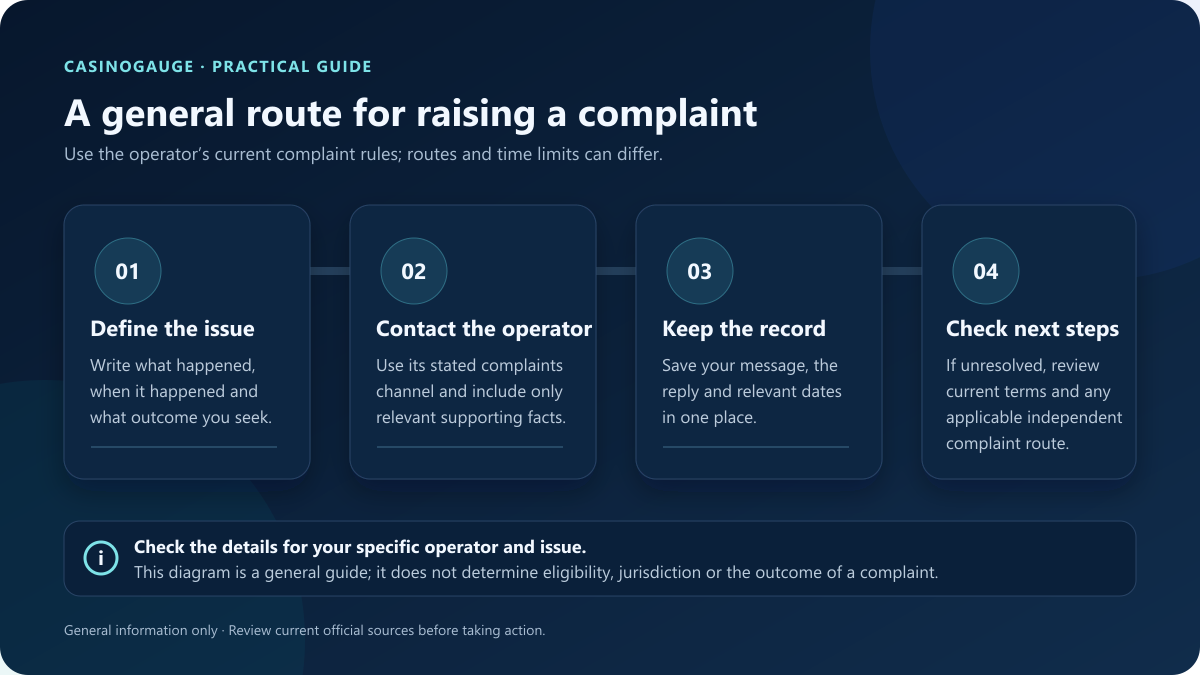
1. Check the complaint route
Find the complaints instructions in the operator’s website or account. Use its formal channel and note the date you submit the complaint. The Commission says gambling businesses must provide clear information about how to complain, their response times and how a customer can escalate an unresolved complaint.
2. Set out the facts clearly
Explain what happened, when it happened and what outcome you are asking the business to consider. Include relevant dates, transaction amounts, account references and the terms or messages involved. Keep copies of what you submit and the replies you receive. Share only information needed to understand the issue, and use the business’s secure channel where available.
- A short chronological timeline
- The transaction, decision or term you dispute
- Relevant account or reference number
- Copies of messages and terms, with dates
- The resolution you are requesting
For a practical evidence file to support your complaint, see our UK casino complaint evidence checklist.
3. Allow the business to investigate
The Gambling Commission’s public guide says the business has up to eight weeks from receiving a complaint to resolve it. The business may respond sooner. The Commission’s guidance also says the eight-week timeframe may pause if you do not respond promptly to a reasonable request for information; keep the request and reply dates so you can follow the timeline. Read its time-limit and escalation guidance for details. Keep its acknowledgement, complaint reference and final response. If it issues a deadlock or final response before eight weeks, check that letter for the next step.
4. Consider Alternative Dispute Resolution (ADR)
If the complaint remains unresolved after the business’s process, you may be able to refer the dispute to an ADR provider. The operator should tell you which provider is relevant and give its contact details. ADR is free to consumers, but the provider decides whether your case falls within its scope and what evidence or time limits apply. Complete the operator’s process first unless the operator has issued an earlier deadlock or final position.
- Read the operator’s final response or deadlock letter.
- Confirm the correct ADR provider for the operator and issue.
- Check the provider’s eligibility, scope and submission requirements.
- Send the requested records and keep proof of submission.
5. Use a regulator or another route for the right issue
The Gambling Commission regulates licensed gambling in Great Britain but does not resolve individual transaction disputes. A concern about an operator’s regulatory conduct can be reported to the Commission, but that is separate from pursuing your own transaction complaint. Advertising, data-protection and other issues may have separate routes.
Keep personal information safe
Use official contact details and secure submission methods. Do not post account numbers, identity documents, payment details or private correspondence publicly. Keep an unedited copy of records for yourself and redact unrelated personal information from copies shared more widely.
Official sources
- Gambling Commission: How to complain — steps for complaints to a gambling business and the eight-week period.
- Gambling Commission: Taking your complaint to an ADR provider — when and how ADR may be used.
- Gambling Commission: Complaints — complaint routes and the Commission’s role.
Last checked: 2 October 2026. These Gambling Commission sources concern Great Britain; regulatory arrangements differ in Northern Ireland. For a factual correction, use our corrections policy.