UK Casino Payment Methods: Deposits and Withdrawals Explained
UK casino payment methods vary: a method shown in a cashier might support deposits, withdrawals or only one of them. This guide shows how to check payment rules for a remote gambling business licensed for customers in Great Britain. Availability depends on the operator, payment provider, account and current terms; a method available at one site may not be offered at another.
18+. Gambling can cause harm and is not a way to make money. This is general consumer information, not financial or legal advice. Northern Ireland has a separate gambling-law framework; this guide describes Great Britain. If you are looking for support, read our safer-gambling controls and support guide.
UK casino payment methods: follow the route
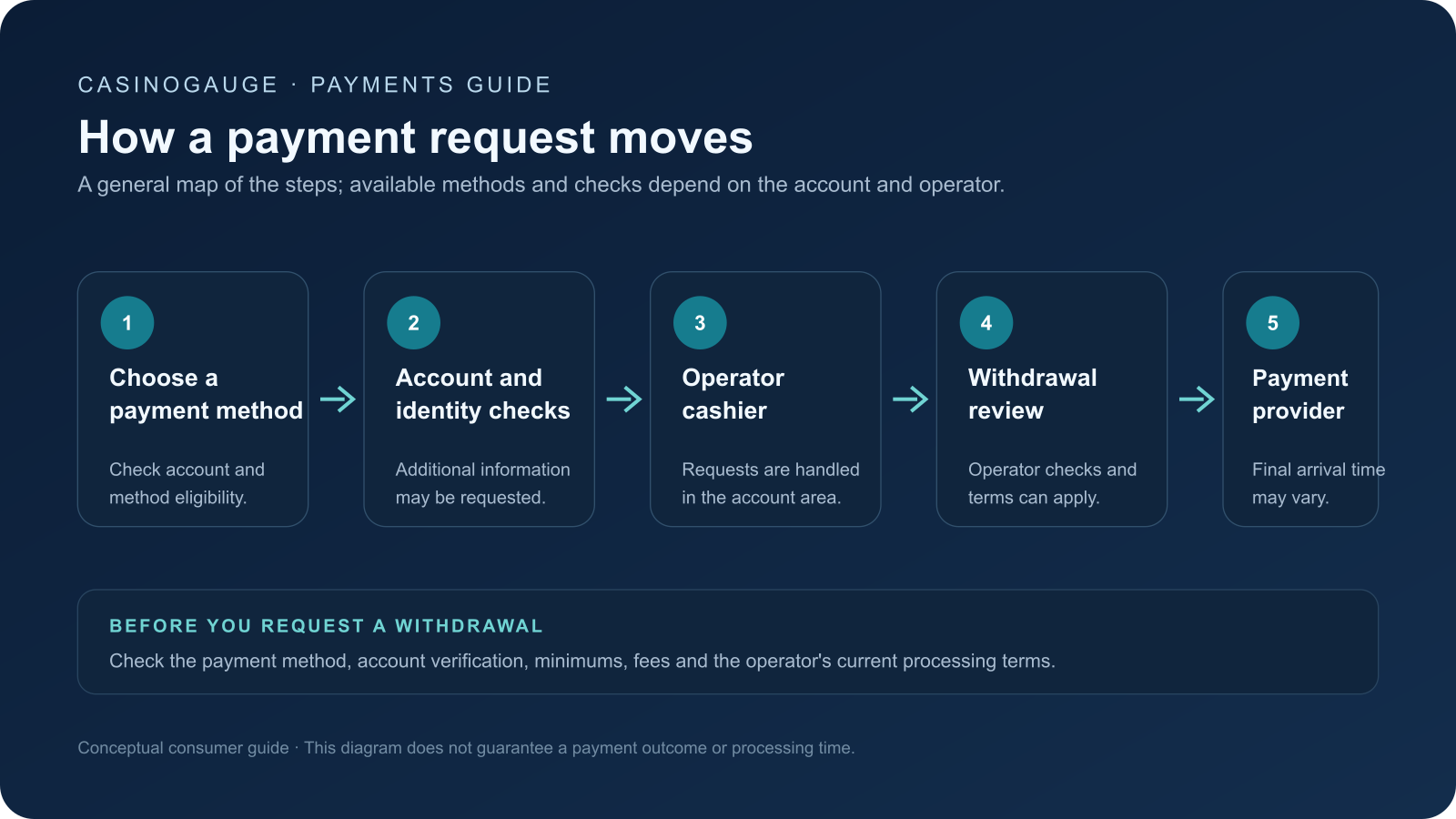
A six-step guide to checking deposit and withdrawal routes, credit-card restrictions in Great Britain, ownership and identity checks, costs and processing terms. Availability varies; no payment or timing is guaranteed.
Source: UK Gambling Commission credit-card guidance (opens in a new tab)Read transcript
CasinoGauge. UK casino payment methods: a six-step field guide. Scope: remote gambling licensed in Great Britain. Conceptual overview only. Availability, checks, limits, fees and processing stages vary by operator, provider, account and method. Northern Ireland has a separate gambling-law framework. Step one, deposit and withdrawal support. A cashier can offer a route for adding funds without supporting withdrawals to that same method. Check each direction separately in the current cashier and written terms, including account-specific conditions. Step two, follow the payment route, not just the logo. Card, bank transfer, open-banking, e-wallet, mobile-wallet and prepaid labels can describe different flows. Check the exact product and provider terms, how payment is authorised, whose account is used and whether the route can receive withdrawals. A logo or availability at another site does not prove availability here. Step three, Great Britain credit-card restriction. Licensed gambling businesses in Great Britain cannot accept credit-card payments for gambling. The restriction also covers credit-card funds routed through an e-wallet or other money-service business. Check the exact debit-card product and current operator terms. Step four, ownership and verification. Check whose name must be on the payment account and what evidence may be required. UK online gambling businesses must verify age and identity before customers gamble. If more information is requested, ask what is needed, why, how to provide it securely and when it will be reviewed. Never disclose an online-banking password or one-time security code to customer support. Step five, fees, limits and stages. Compare minimum and maximum deposits, withdrawal limits and frequency caps, operator bank and provider fees, account and transaction currency, conversion costs and any offer terms that affect eligibility. Provider or bank transfer time and operator review are different stages. An estimate is not a guarantee for an individual payment. Step six, check the exact route before acting. Confirm the exact cashier and matching withdrawal terms. Closed-loop returns are strongly recommended as good practice, not a guarantee every route accepts returns or funds arrive at once. The payment method does not determine customer-funds protection; check the operator disclosed rating separately. Gambling can cause harm and is not a way to make money. This is general consumer information, not financial or legal advice.
Deposits and withdrawals are separate questions
A payment option can accept deposits but not withdrawals. A business may ask you to withdraw to a particular eligible method, or may use a closed-loop process that sends withdrawals back through the method used for the deposit. The Gambling Commission describes closed-loop systems as best practice and strongly recommends them to operators; it does not mean every payment method supports a return payment or that funds arrive immediately. Read the Commission’s closed-loop payment guidance and the operator’s current cashier instructions and withdrawal terms before relying on a method.
Provider transfer time and operator review time are different stages. A displayed estimate is not a guarantee for an individual payment. If a route, fee or limit is unclear, ask the operator to explain the current rule in writing and keep the reply.
Common payment routes
Debit cards
Check which card network and card types the operator accepts, whether the card must be in your name, and whether it supports withdrawals as well as deposits. Do not assume that a card logo means every card product is eligible or that the same route can be used for a cash-out.
Credit cards
Licensed gambling businesses in Great Britain must not accept credit-card payments for gambling. The restriction also covers credit-card funds routed through an e-wallet or other money-service business. See the Gambling Commission’s credit-card guidance and its explanation of using e-wallets to bet online.
Bank transfer and open banking
These labels can describe different payment flows. Check how the operator and payment provider describe the authorisation, the account used and whether the route can also receive withdrawals. Use only a payment account you own and are authorised to use. Never provide an online-banking password or one-time security code to someone claiming to be customer support.
E-wallets and digital wallets
An e-wallet may hold or route funds, while a mobile wallet may pass a tokenised debit card. Providers set their own restrictions, and operators must follow the credit-card rules for gambling payments through wallets. Check both the cashier and current provider terms. Do not infer that a route is accepted because the wallet works elsewhere.
Prepaid vouchers and cards
Check whether the specific product is accepted for deposits, withdrawals or only one of those. Review its own terms for fees, expiry, refunds and identity requirements as well as the operator’s terms. Do not assume unused value can be withdrawn through a gambling account.
Identity and account checks
Ask whether the payment account must be in the same name as the gambling account and what evidence may be required to confirm identity or payment ownership. A gambling business may need further information to meet legal obligations, including checks relating to financial crime. The Gambling Commission says online gambling businesses must verify age and identity before a customer gambles, and should not wait until a withdrawal request to ask for information they could have requested earlier. It notes that there may be circumstances when further information is needed at withdrawal to fulfil legal obligations. Read its age, identity and financial verification guide. For a plain-English overview of when checks happen and what to do if additional checks delay a withdrawal, see our UK casino ID-check guide.
If a withdrawal is delayed, ask which specific check is outstanding, what information is needed, how to provide it securely and when the operator expects to review it. Keep a record of the request and response. Our complaint-resolution guide explains how to follow up an unresolved dispute.
Fees, limits and processing terms
Before relying on a method, look for:
- minimum and maximum deposits;
- withdrawal minimums, maximums and daily or monthly caps;
- fees charged by the operator, bank or payment provider;
- account and transaction currency, including conversion costs;
- whether the method supports deposits, withdrawals or both;
- the stages in the stated processing time and what starts or pauses the clock;
- any promotion terms that affect eligibility for a payment route.
Can I withdraw a casino deposit without wagering it?
For an operator licensed to serve customers in Great Britain, the Gambling Commission says customers must be allowed to withdraw money in their deposit balance at any time, even if a bonus is pending or active. Wagering requirements must not apply to play made with a deposit balance. The deposit and bonus balances must be shown separately; different terms can apply to bonus funds and bonus winnings. Check which balance the money is in and read the promotion’s terms before drawing conclusions. See the Commission’s guidance on withdrawing deposits and deposit winnings.
An operator must not charge a customer who wants to withdraw their entire deposit balance. For a partial withdrawal, a reasonable limit on the size or number of transactions may be allowed under fair, transparent terms. A processing fee must be explained before deposit and must not exceed the direct cost of processing the withdrawal. Necessary identity or other regulatory checks can still apply. See its maximum-withdrawal guidance.
If an operator says a withdrawal is restricted, ask it to identify the balance involved, point you to the applicable term and explain any check or fee in writing. If the issue is not resolved, follow the operator’s complaints process; our complaint-resolution guide explains the next steps. For the difference between bonus funds and cash balances, see our bonus-terms guide.
Payment method does not determine funds protection
The payment route does not determine what happens to money held by an operator if it becomes insolvent. The Gambling Commission says businesses must tell customers what level of protection applies to customer funds. Read the operator’s terms for its stated rating and arrangement. Segregation is not automatically a guarantee that every balance will be repaid. The Commission explains the categories in its guide to what happens to customer money if a gambling business goes bust.
A quick payment checklist
Before making a payment, verify the exact business and website domain against the Gambling Commission public register, then ask:
- Is this method available on this exact site today?
- Can it be used for a deposit, a withdrawal or both?
- Does the account have to be in my name?
- What limits, fees, currencies and processing stages apply?
- Could offer terms change eligibility?
- What customer-funds protection rating does the operator disclose?
- Are the current cashier details consistent with the written terms?
Official Gambling Commission guidance linked on this page was checked on 24 September 2026. Payment availability and operator terms can change; check the current source before relying on a specific option. If you choose to gamble, set a limit you can afford to lose and use the account controls available to you.